On this page
Red and green already bring strong seasonal associations, so a refined display rarely needs more of everything. The secret is deciding which elements do the talking: rich evergreen texture, a measured dose of red, and a supporting neutral. Treat the light as one layer of the composition—not as a reason to illuminate every branch, railing, and window at once.
Start with a simple color plan
Pick one red as your lead: cranberry, classic scarlet, or a deeper burgundy. Then choose greenery that complements it, whether that is fresh-looking fir, broad-leaf magnolia, or an artificial evergreen with a more muted tone. The exact hues are a style choice, not a formula; seeing the materials together in your home’s actual light is more useful than judging each item alone.
Add just one secondary neutral to soften the contrast. Warm white ribbon, natural wood, ivory, or a restrained metallic can provide breathing room without turning the scheme into a new palette. For example, pair deep green garland with cranberry ribbon, then repeat small warm-white details at the entry and on a nearby tree. If your existing fixtures or room finishes feel cool, test a small sample before committing to a large area.
Let texture do some of the decorating
When every element is glossy or brightly colored, the display can feel busy even if it uses only two hues. Layer differences in texture instead: fine evergreen tips beside broad leaves, a matte ribbon against a few polished ornaments, or pinecones among smooth baubles. A simple wreath can feel dimensional without being packed with ornaments.
Think of greenery as the visual base and bright red as punctuation. On a mantel, for instance, a loose evergreen garland might carry most of the volume, with red ornaments grouped in two or three small clusters rather than scattered evenly from end to end. At the front door, a wreath can repeat the same red accent and neutral ribbon, creating a connection without adding another competing decoration.
Edit ornament scale and repetition
Before hanging ornaments, sort them by size and finish. Choose one dominant size, then use smaller pieces as accents; a few larger ornaments can anchor a tree or wreath, while tiny details help fill selected gaps. Repeating a shape or finish creates rhythm. A mix of every size, color, and shine level can make each item demand attention.
Try this quick layout: place the largest red ornaments in a loose triangle or in a few deliberate clusters, then step back and fill only where the display looks unbalanced. Repeat one smaller neutral ornament nearby, but leave some greenery visible. The goal is not mathematical symmetry—it is a sense that the choices belong together. If the display looks cluttered from across the room, remove a handful before adding something new.
Give each view one focal point
Walk through the space from the viewpoints guests actually use: the sidewalk, the front door, the living-room entrance, or the dining table. Decide what should catch the eye first. It could be the wreath, a decorated tree, or a single window arrangement. Let nearby garland and smaller accents support that feature rather than compete with it.
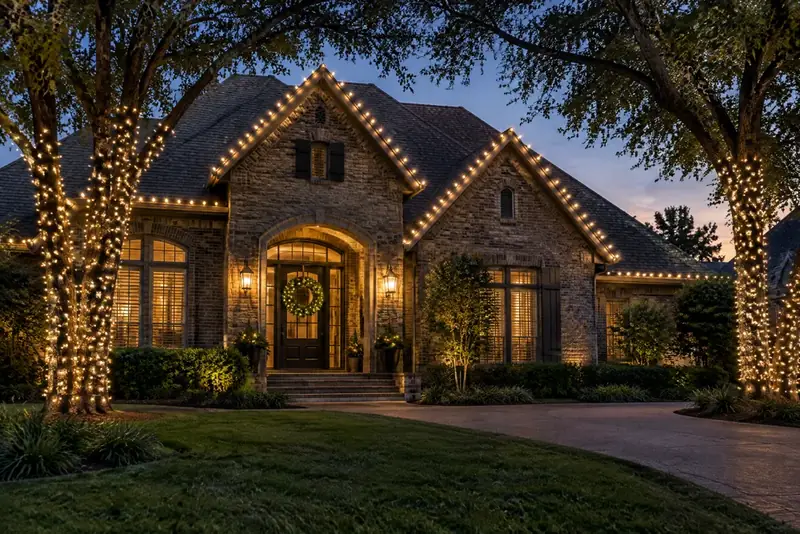
This is where balancing decor against emitted light matters. A red bow, berries, and layered greenery remain visible by day; lights add a glow after dark. You might illuminate one roofline or a single tree while keeping porch garland and window trim mostly unlit. Indoors, choose where a lit tree is most effective instead of adding twinkle lights to every surface. Leaving some areas quiet makes the focal point easier to read.
For a coordinated exterior, consider how wreaths, garland, and tree wrapping relate in scale and color before selecting individual pieces. Lighting Up Oklahoma’s wreaths, garland, and tree-wrapping service is the related service for this kind of greenery-focused decorating.
Finish with a practical safety edit
A beautiful arrangement still needs to work as part of the room. Keep decorations from blocking exits, walking routes, or usable handrails. The U.S. Fire Administration advises keeping Christmas trees at least three feet from heat sources such as fireplaces, radiators, space heaters, candles, and heat vents. Keep other flammable decor away from heat as well, and choose flameless candles if a flame would sit near greenery or ribbon.
Before using holiday light strands, inspect them and discard strands with frayed or pinched wires. Follow the manufacturer’s instructions for how many strands may be connected; there is no one safe number for every product. If a set is damaged, gets wet where it should not, overheats, smells burnt, or repeatedly trips a protective device, stop using it and seek qualified help rather than trying to repair it.
The final check is simple: look at the whole scene from a few steps back, remove one competing accent, and confirm that people can move through the space comfortably. A restrained red-and-green palette can feel abundant through texture and repetition—without making every surface, or every bulb, a focal point.
For more seasonal decorating safety details, see the U.S. Fire Administration’s Holiday Fire Safety guidance and the NFPA Holiday Fire Safety Tips.
Sources
Explore Wreaths Garland Tree Wrapping.
See the service overview, then tell us what you are considering for your property.