On this page
Garland can make a front entrance feel finished and carry the same holiday texture indoors, but a doorway and a staircase do real work every day. The best design leaves that work uninterrupted. Think of the exterior door as a frame to compose and the staircase as a route to protect—not as two places to cover as much surface as possible.
Frame the front door, not the path
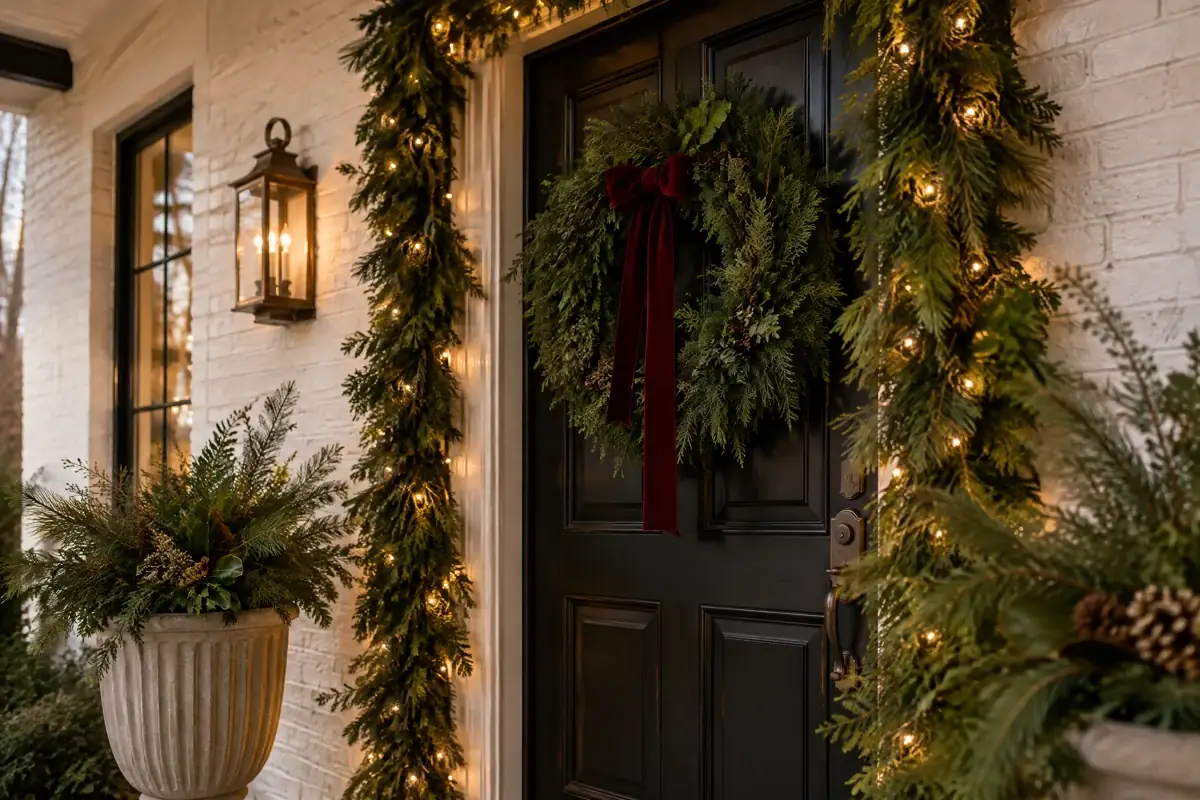
Start with a view from the sidewalk or driveway. A clean line across the top of the door with short, balanced drops at the sides can read as one welcoming frame. On a house with a prominent porch column or lantern, an asymmetrical sweep around one upper corner may feel more intentional than wrapping every nearby feature. These are design options, not rules: choose the outline that suits the trim and does not compete with a wreath, sign, or other focal point.
Before selecting greenery, open and close the door fully. Check that garland will not catch on the door edge, obscure a lock, cover a house number or doorbell, interfere with a storm door, or snag on clothing and bags. Look at the threshold and the approach from more than one angle, including after dark. Keep the walkway and the space needed to open the door clear; avoid trailing ends, low loops, or cords where someone steps.
For a low-profile entry, use a single garland line across the top rather than adding side drops. A broad doorway can take a more substantial outline, while a narrow door may look better with a top line and one short accent. If the entry already has strong trim or a wreath, let the garland be the supporting layer. Leaving some trim visible often makes the decoration look considered instead of crowded.
Choose materials and attachment methods for the exact location. Outdoor decor and any light set should be identified as suitable for outdoor use when used outside, and used according to the maker’s instructions. Select supports intended for the surface and the garland; do not improvise fasteners, overload a door, or attach anything where it can damage weather seals or interfere with operation. If the surface or attachment is uncertain, leave that section undecorated or get qualified help.
Treat the staircase as a handrail first
A staircase garland should never turn the handrail into decoration that is difficult to grasp. Keep the surface people hold clear from the first step to the last, with no lights, ties, bows, or greenery crossing the grip area. Do not wrap the garland over the top of the rail or let it hang into the stair width. If a secure arrangement cannot leave a continuous, usable handrail and clear steps, skip the rail.
Instead, consider a garland along the side of a landing, around a stable newel post only if it does not hinder the rail or movement, or on a nearby mantel or console. For example, a modest accent at the bottom newel can echo a door wreath without creating a long swath beside every step. A simple landing arrangement may be a better choice in a busy household or narrow stairwell. Preserve exits and the full route through the home, especially where the stairs serve as a way out.
Do not assume a support is safe just because it seems to hold. Use attachment products only as directed and only on compatible surfaces; avoid nails, loose wire, slippery ties, or other improvised mounting. Keep cords secured away from treads and traffic paths. Take a step back and inspect the staircase from both the top and bottom: look for anything that narrows the route, can snag a sleeve or bag, or could shift when brushed.
Keep greenery and lighting low-risk
Garland may be natural or artificial, but neither should be treated as fireproof. The U.S. Consumer Product Safety Commission’s holiday decoration guidance advises using non-combustible or flame-resistant trimmings and keeping decorations away from open flames and electrical connections. The U.S. Fire Administration’s holiday safety guidance says to read manufacturers’ instructions for how many light strands to connect and to discard strands with frayed or pinched wires. For a garland display, that means checking labels and instructions for the specific decor and lights rather than relying on a universal string limit.
Avoid candles near garland, including at a doorway or on a stair landing. A battery-operated flameless candle can suggest a candlelit look without an open flame; keep even battery decor stable and out of the way. Keep greenery clear of fireplaces, heaters, heat vents, and other hot surfaces, following product directions rather than guessing at a safe clearance. If a strand or garland becomes damaged, wet inside, unusually hot, smells burnt, or repeatedly trips a protective device, stop using it and seek qualified help.
A quick placement check
Before calling the display done, try this short review:
- Open the front door and storm door through their full range; confirm nothing catches or hides hardware.
- Walk the approach and staircase as usual. The entry, stair treads, handrail, and exits should remain usable.
- Check every attachment and cord against the product instructions; remove anything loose, damaged, or in the way.
- View the arrangement from outside and inside, in daylight and after dark. Edit one detail if the garland crowds trim or competes with another focal point.
A few intentional lines can connect the front entrance to the interior without asking anyone to sidestep, duck, or let go of the rail. For more help planning garland accents as part of a holiday display, explore wreaths, garland, and tree wrapping.
Sources
Explore Wreaths Garland Tree Wrapping.
See the service overview, then tell us what you are considering for your property.