
On this page
Holiday tables look their best when the decoration supports the gathering instead of competing with dinner. Start with the table you have, the dishes you plan to serve, and the people who need to reach across it. A little rehearsal helps you keep the seasonal details while leaving room for plates, conversation, and passing bowls.
Begin with the meal, not the centerpiece
Before choosing decor, decide whether food will be served family-style on the table or plated elsewhere. That one choice determines how much surface you can devote to a runner, greenery, candles, and serving pieces. Measure the usable tabletop, including the space needed for place settings, then bring out the dishes and serving bowls you expect to use.
Do a quick dry run: lay down the tablecloth or runner, set a plate and glass at each seat, and arrange the serving pieces. Leave a usable lane through the middle for shared food, or reserve a separate nearby surface for dishes that will not fit. If a bowl needs to be lifted over a centerpiece or passed around a candle, the layout needs editing. Keep the usual path to seats and exits clear, too.
Make the centerpiece low, stable, and easy to move
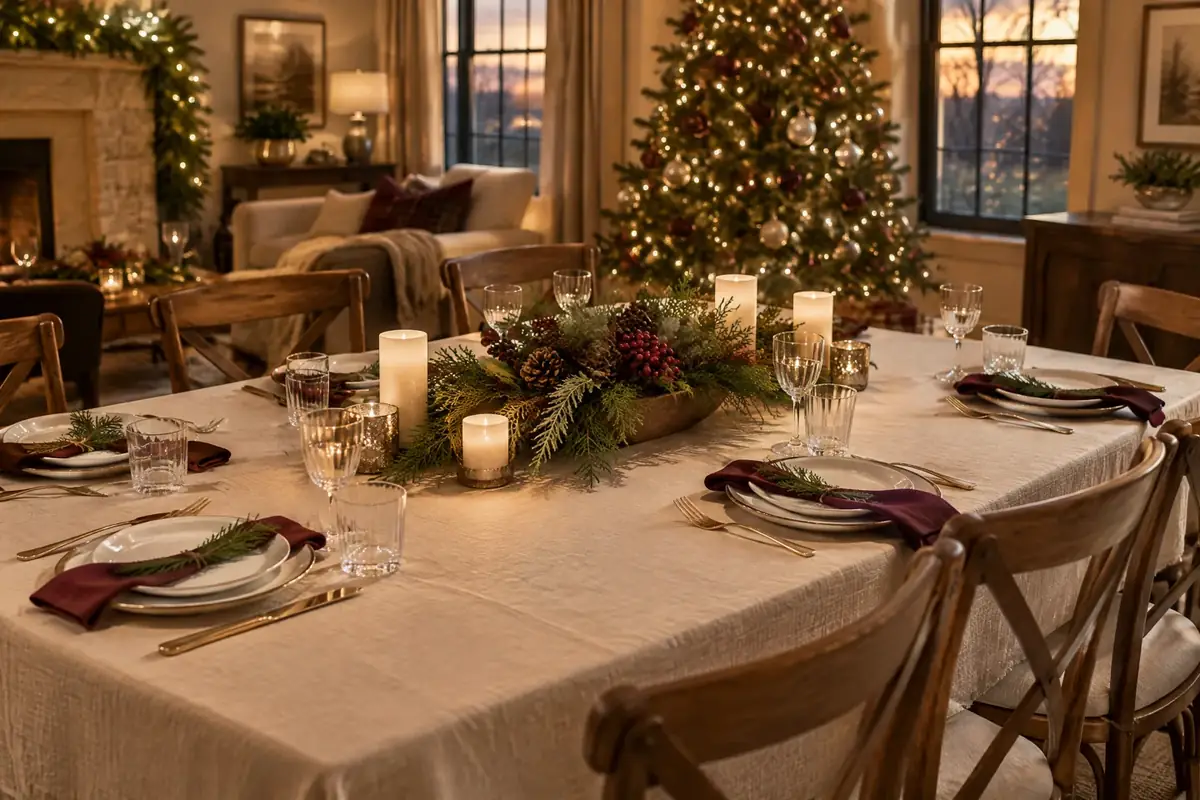
A centerpiece should look inviting from a seated position without becoming a visual wall. Try a shallow bowl of ornaments, a short cluster of small vases, or a narrow line of greenery rather than one tall arrangement. These are design options, not fixed rules: adjust the scale to your table and leave gaps where serving dishes need to land.
Check the arrangement from several chairs. Can guests see one another? Can someone set down a platter without knocking into it? If not, split the display into two or three smaller pieces, or move the main arrangement to a sideboard before dinner. Choose a stable base and avoid pieces that wobble when the table is nudged. Keep fragile ornaments, loose beads, and delicate stems away from the edges where they may be brushed by sleeves or dropped utensils.
Fresh greenery can add texture, but it does not need to cover every inch. A short garland down the center can be gathered into a neat bundle and lifted away when food arrives. Do not tuck lit candles into greenery or leave decorative material close to a flame. For a coordinated look beyond the dining room, repeat one ribbon or evergreen color at the entry; Lighting Up Oklahoma's wreaths, garland, and tree-wrapping service describes the related seasonal decor category.
Set places for comfort and flexibility
Treat each setting as a practical landing zone: plate, napkin, cutlery, and the glassware the meal actually needs. Fold a napkin simply or tie it with a reusable ribbon; skip bulky favors that take up the spot where a drink or side plate should go. If you use a place card, keep it easy to see and out of the way.
A mix-and-match table can feel intentional when you repeat one element. Pair everyday plates with cloth napkins in a seasonal color, or use a few different glass shapes while keeping the linens consistent. A neutral base—ivory, natural linen, or a familiar solid-color cloth—can work across more than one holiday. Add one accent such as evergreen, berry red, brushed gold, or deep blue rather than introducing a new motif at every seat.
Use light carefully
For a soft glow without an open flame, choose battery-operated flameless candles or another low-profile decorative light and follow its product instructions. Avoid placing cords where people walk, pull chairs, or reach for food; a cord crossing a route turns ambiance into an obstacle. Keep decorative lighting out of serving areas where spills and hot dishes are likely.
If you prefer real candles, plan their location before adding flowers, paper, napkins, or greenery. The U.S. Fire Administration advises keeping candles at least 12 inches from anything that burns, setting them in stable holders, and placing them where they cannot be knocked over easily. NFPA's candle guidance also emphasizes that a candle is an open flame and should be blown out before leaving the room or going to bed. If your table cannot provide that separation, skip the flame. Do not leave a burning candle unattended.
A simple setup sequence
- Clear the table and decide where food will be served.
- Place the cloth or runner, then set out actual plates, glasses, and serving dishes.
- Add one low centerpiece, checking sightlines and reaching space from the chairs.
- Add only the accents that still leave room for the meal.
- Before guests arrive, remove or relocate any item that wobbles, crowds a place, blocks a route, or sits too close to a flame.
The common mistake is decorating the whole tabletop first and trying to squeeze dinner in afterward. Let the menu and the people set the footprint; then use color, greenery, and a few personal details to make the remaining space feel festive. When the evening ends, washable linens and a small box of reusable accents make next year's table simpler to assemble.
Sources
Explore Wreaths Garland Tree Wrapping.
See the service overview, then tell us what you are considering for your property.